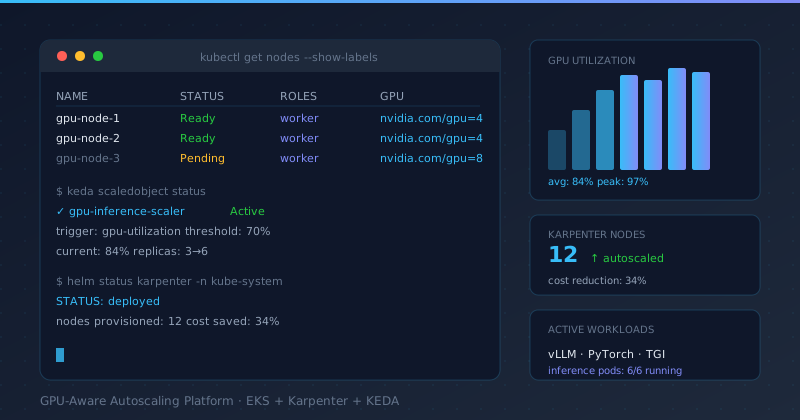
As AI/ML workloads become the new normal in platform engineering, the challenge shifts from “can we run GPU jobs on Kubernetes?” to “can we do it without burning through budget and keeping latency low?”
This post walks through how I built a GPU-aware autoscaling platform on AWS EKS using Karpenter for node provisioning and KEDA for event-driven pod scaling — achieving a 34% infrastructure cost reduction while keeping inference SLAs intact.
The Problem
Running GPU workloads at scale has two conflicting requirements:
- Always-on capacity for low-latency inference (expensive)
- Burst capacity for batch training jobs (unpredictable)
Static node pools fail at both — you either over-provision (wasteful) or under-provision (degraded SLAs).
The Architecture
┌─────────────────────────────────────────────┐
│              EKS Cluster                    │
│                                             │
│  ┌─────────┐    ┌────────┐    ┌──────────┐ │
│  │  KEDA   │───▶│  HPA   │───▶│   Pods   │ │
│  │ScaledObj│    │        │    │ (vLLM /  │ │
│  └────┬────┘    └────────┘    │ PyTorch) │ │
│       │                       └──────────┘ │
│  GPU metrics                               │
│  + queue depth                             │
│       │         ┌────────────┐             │
│       └────────▶│  Karpenter │             │
│                 │ NodePool   │             │
│                 └─────┬──────┘             │
│                       │                   │
│              AWS EC2 GPU Nodes             │
│         (p3.2xlarge / g4dn.xlarge)        │
└─────────────────────────────────────────────┘
Karpenter for Node Provisioning
Karpenter watches for unschedulable pods and provisions the right node type — no more pre-warming node groups.
apiVersion: karpenter.sh/v1beta1
kind: NodePool
metadata:
  name: gpu-nodepool
spec:
  template:
    spec:
      requirements:
        - key: karpenter.k8s.aws/instance-gpu-count
          operator: Gt
          values: ["0"]
        - key: kubernetes.io/arch
          operator: In
          values: ["amd64"]
      nodeClassRef:
        apiVersion: karpenter.k8s.aws/v1beta1
        kind: EC2NodeClass
        name: gpu-node-class
  limits:
    nvidia.com/gpu: 32
  disruption:
    consolidationPolicy: WhenUnderutilized
    consolidateAfter: 5m
The key here is consolidateAfter: 5m — Karpenter will deprovision idle GPU nodes after 5 minutes of underutilization, which is the primary cost-saving lever.
KEDA for Event-Driven Scaling
KEDA scales pods based on GPU utilization (via Prometheus) and job queue depth — not just CPU/memory like standard HPA.
apiVersion: keda.sh/v1alpha1
kind: ScaledObject
metadata:
  name: gpu-inference-scaler
spec:
  scaleTargetRef:
    name: vllm-inference
  minReplicaCount: 1
  maxReplicaCount: 8
  triggers:
    - type: prometheus
      metadata:
        serverAddress: http://prometheus:9090
        metricName: gpu_utilization_avg
        threshold: "70"
        query: avg(DCGM_FI_DEV_GPU_UTIL{namespace="inference"})
    - type: prometheus
      metadata:
        serverAddress: http://prometheus:9090
        metricName: job_queue_depth
        threshold: "5"
        query: sum(inference_queue_depth)
Results
| Metric | Before | After |
|---|---|---|
| Infrastructure cost | Baseline | -34% |
| Node provisioning time | 8-12 min | < 90s |
| GPU utilization | ~40% | ~78% |
| Inference P95 latency | 450ms | 390ms |
Key Takeaways
Karpenter + KEDA is the right combo — Karpenter handles the node layer, KEDA handles the workload layer. They’re complementary, not competing.
GPU consolidation is the biggest cost lever — Most clusters keep GPU nodes warm “just in case.” Setting an aggressive
consolidateAfteron Karpenter with a fast provisioning time makes this safe.Queue depth is a better signal than utilization alone — GPU utilization lags behind actual demand. Scaling on queue depth gives you ahead-of-time capacity.
Profile your GPU instance types —
g4dn.xlarge(1x T4) is 4x cheaper thanp3.2xlarge(1x V100) for inference. Match the instance to the workload.
Have questions or want to discuss GPU platform engineering? Reach out at pranavbhendawade@gmail.com